
A guide to understanding concrete formwork systems
Like every critical area of your building project, concrete formwork is very important to get right. Whether you are a seasoned trade professional or new to formwork, there are some basic fundamentals to know to help you get start or to refresh your trade knowledge. Building your reputation to win the next job is what Big River is all about and we have written this helpful formwork guide to remind you of the key steps, and help you select the right product for the right concrete formwork job. With over 130 years of timber and formwork experience, you can always talk to any of our helpful and knowledge team and our formwork trade specialists.

Key formwork fundamentals
Our helpful guide will go through the main area of concrete formwork to make understanding easier.
Download the PDF 'Concrete Formwork System Guide' for the perfect concrete formwork installation

Why great formwork matters
The trade that shapes every pour
Concrete only ever looks as good as the form it was poured into. The formworker sets the line, level, dimension and finish of the finished structure before a single load of concrete arrives – which makes it one of the most skilled and consequential trades on any site. Get the formwork right and everything downstream runs smoothly; get it wrong and the errors are cast in concrete, literally.
Safety first, always
The National Construction Code requires structures to perform under load both in service and during construction. Formwork carries the full wet-concrete load until it cures – so it must be engineer-designed, correctly braced and built from compliant materials. Formwork failure risks time, money, injury and lives.
Quality is set here
Line, level, plumb, dimensional accuracy and surface finish are all locked in by the formwork. The reo fixer, concreter and every following trade inherit whatever the formworker set out. Accurate forms mean less grinding, patching and rework later.
Programme & cost
Formwork is typically the single largest cost component of a concrete structure. Fast, reusable, well-planned forms keep the pour cycle moving and the budget intact – which is exactly where good material selection and set-out pay for themselves.
The mark of a professional
Straight edges, crisp arrises, tight joints and a clean off-form face are the visible signature of a skilled formworker. This guide is about consistently hitting that standard – and being able to prove the materials and methods behind it.
Plan, design before you build
Design, compliance and set out (before materials arrive)
Get the paperwork and the layout right first. Confirm the formwork is engineer-designed.
All formwork must be designed by a qualified structural engineer to meet the NCC and Australian design standards for expected construction loads – this is a legal responsibility, not an optional step.
Check the drawings for line, level, slab thickness and cover.
Set your datum and reference lines from the site benchmark. Confirm finished floor levels, falls to drains, and step-downs to wet areas before you set out.
Verify material suitability for the application.
The designer/installer is responsible for ensuring materials are suitable for the job. Keep evidence of suitability – ask the supplier for AS 6669 certification and structural data.
Plan the pour sequence and reuse cycles.
Decide up front how many times each panel needs to be reused – this drives your formply grade selection and your budget.
Order everything from one supplier where possible.
Formply, LVL bearers, edgeboard, steel decking, bracing, form ties, fixings and release agent ordered together means compatible components, one delivery and fewer gaps on site.
PRO TIP
Book crane-truck delivery to land panels close to the pour. Double-handling heavy sheets across a site is wasted labour and a common source of edge and face damage.
Residential concrete slabs and footings
Edge forms, set-out and bracing
Plan and design before you build. The bread and butter pour – done properly.
Slab-on-ground, waffle pods, strip footings and edge beams. The goal is a straight, level, correctly-dimensioned slab with clean edges that need minimal finishing.
Use a purpose-made LVL edgeboard (RedEdge), not random timber lengths.
Engineered edge forms like RedEdge are dead-straight, stiff and stay put under concrete pressure – giving a true screed rail for a flat slab and a crisp, square edge. Sawn timber bows and twists, putting waves in the slab edge.
Set edges to line and level, then double-check diagonals.
Measure diagonals to confirm the form is square. Re-check level along the top of the edgeboard – this is the surface the concreter screeds off.
Stake and brace at close, regular centres.
Wet concrete exerts significant outward pressure. Adequate pegs and external bracing stop blow-outs and bulging edges. Straighter edge material needs fewer stakes.
Seal joints and check for gaps at the base.
Grout loss under or between forms causes honeycombing and ragged edges. Close the gaps before the pour.
Confirm penetrations, set-downs and cast-in items are fixed.
Plumbing penetrations, box-outs, step-downs and cast-in fixings must be secured against float before concrete goes in.
WHY LEVEL EDGEBOARD WINS
Low moisture absorption means it won’t swell or draw water from the slab edge; it strips clean and reuses across many pours, dropping your cost-per-pour well below one-use timber despite the higher sheet price.
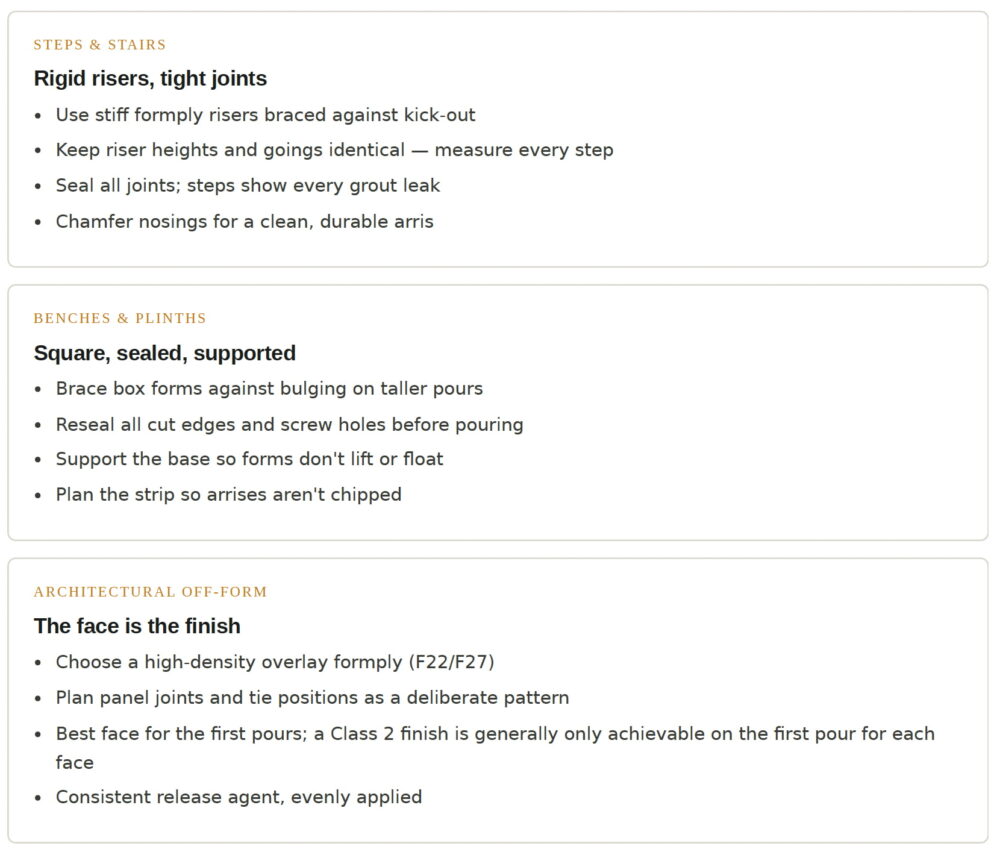
Steps, benches and off-form finishes
Common commercial formwork where the finish is on show
Stairs, seating, plinths, feature walls and any exposed concrete where the surface is the finish. Here, formply selection and on-site care decide whether you achieve a clean architectural result.
- Check with your architect to ensure you are crystal clear on the vision for the final build.
- Check with your engineer to make sure the construction meets relevant standards.
- Check with your builder to ensure the sequence of the concrete pour suits the project schedule.
For more complicated and unique concrete formwork designs it may be necessary to do a sample to ensure you have selected the right formwork products to give you the desired result. Talk to your Big River Formwork Specialist to learn from the experience we have from other jobs…we are here to help you build your reputation to win the next job.

On-site practices for a quality surface
Off-Form Finishing
Most concrete surface defects come from water absorbing into the formply. Control water ingress and you control the finish.
Identify and remove damaged formply from use.
A damaged face imprints straight onto the concrete.
Reseal all cut edges, holes and fixings before pouring.
Apply a release agent to reduce face water absorption and make stripping easier.
Allow a 2mm expansion gap with edge or face sealing tapes.
Take care with concrete vibrators so the panel surface isn’t gouged or overworked.
Lower form panels into place – never drop them – to protect faces and edges.
Use hot-dipped galvanised, alloy or stainless nails to prevent rust staining.
Store panels under cover, never wrapped in plastic. Trapped moisture ruins faces. Stack flat, off the ground, out of the weather.
SET EXPECTATIONS
Even with perfect practice, a Class 2 finish is generally only achieved on the first pour for each face. Plan your best panels for the visible work.
Formply - choosing the right material
Genuine compliant formply vs copy-cat products
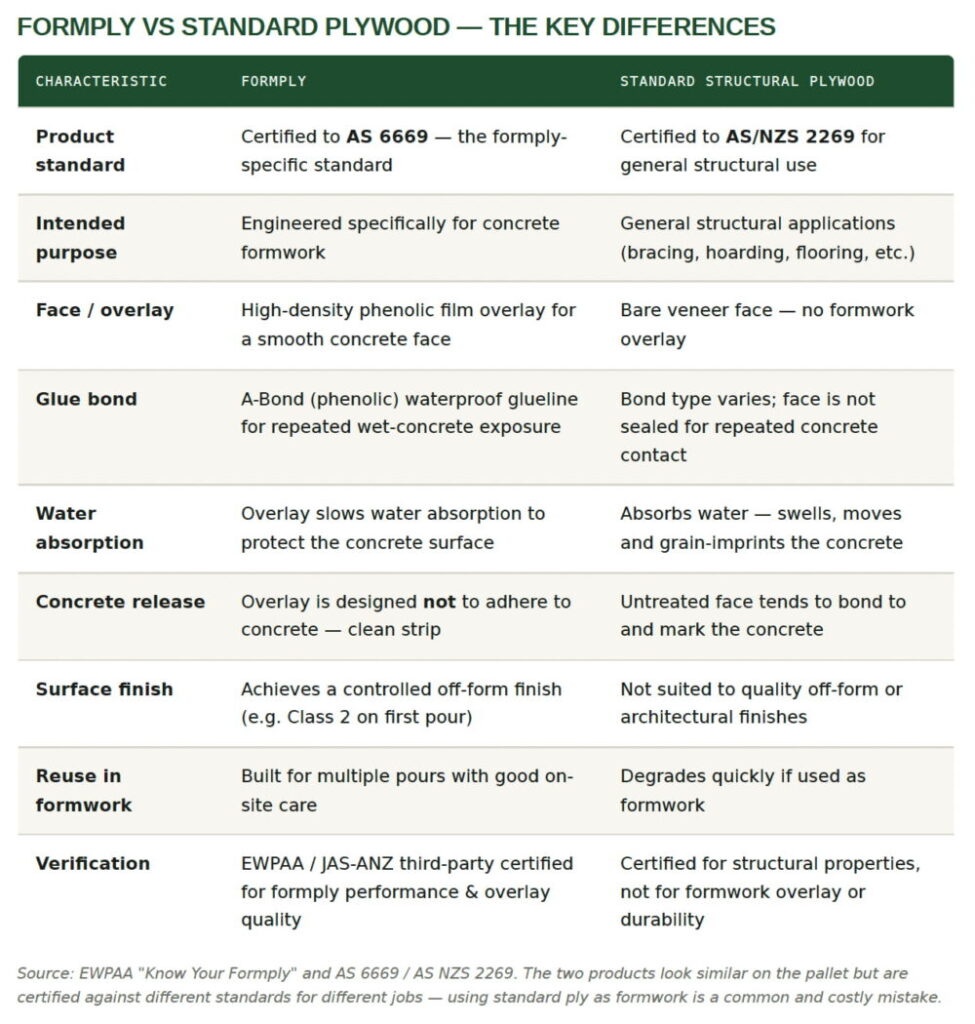
Formply is structural plywood with a phenolic resin overlay (a high-density film face) specifically engineered for concrete. It is not the same as standard structural plywood: formply carries its own certification under AS 6669 and uses an A-Bond (phenolic) glueline for full waterproof performance under repeated wet-concrete exposure. Standard ply certified to AS/NZS 2269 lacks the overlay needed for clean release and finish.
The characteristics to look out for quality formply are:
- Product standard
- Intended purpose
- Face / overlay
- Glue bond
- Water absorption
- Concrete release
- Surface finish
- Reuse in formwork
- Verification
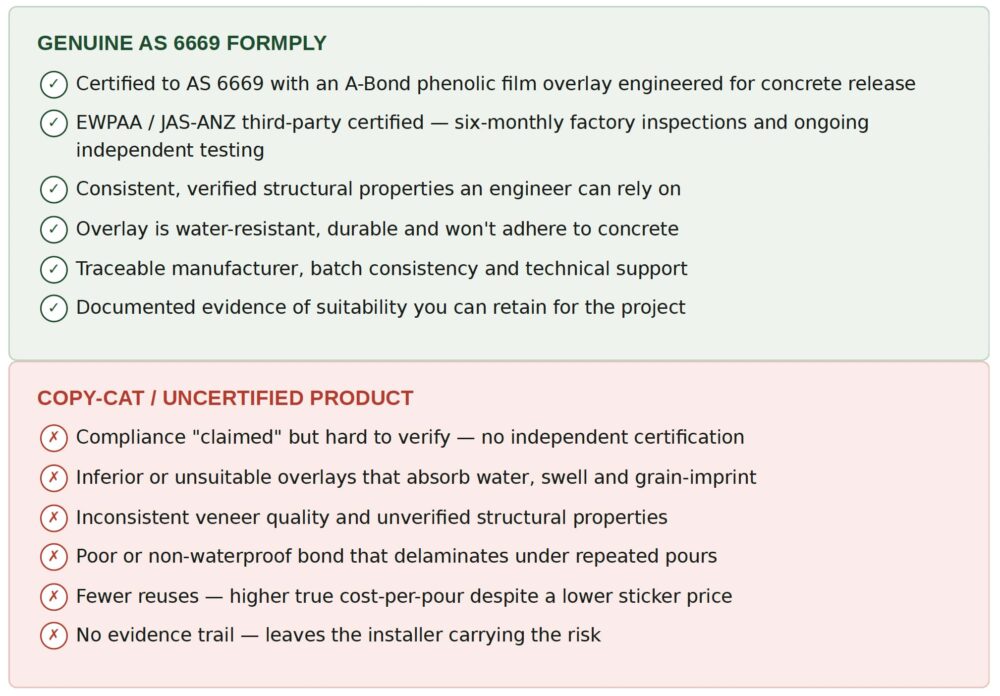
Compliant formply vs copy-cat products
Ask 3 questions before you buy
Cheaper look-alike formply can appear identical on the pallet but fail where it counts
A false economy that risks the pour, the finish and the compliance chain. Under Australian law the manufacturer or importer must ensure any claim of compliance is accurate, but a claim alone may not prove suitability. Always request the evidence.
1. Is it certified to AS 6669?
Not AS/NZS 2269 (that’s standard structural ply, not formply).
2. Is the manufacturer EWPAA / JAS-ANZ certified?
That means independent, ongoing verification – not a self-made claim.
3. Can the supply provide the evidence?
Structural data, overlay/durability results and certification, kept on file for your project. If the answer to any of these is unclear, the product isn’t proven for your pour – regardless of the price.
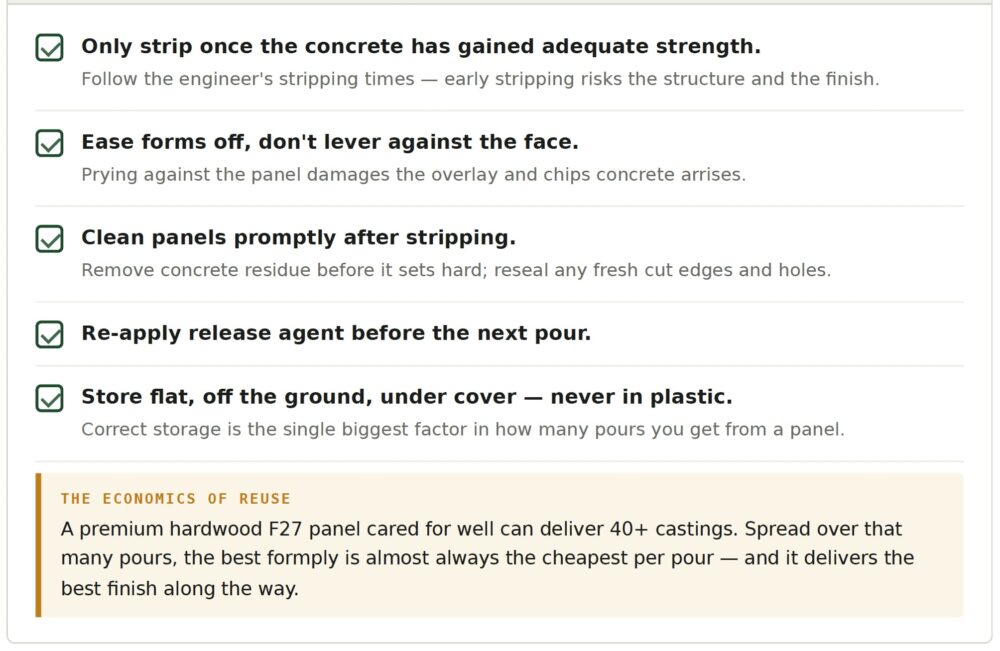
Strip, reuse and store your formply
Stripping and panel care
Protect the investment – every panel is money
Only strip once the concrete has gained adequate strength.
Follow the engineer’s stripping times – early stripping risks the structure and the finish.
Ease forms off, don’t lever against the face.
Prying against the panel damages the overlay and chips concrete arrises.
Clean panels promptly after stripping.
Remove concrete residue before it sets hard; reseal any fresh cut edges and holes.
Re-apply release agent before the next pour.
Store flat, off the ground, under cover – never in plastic.
Correct storage is the single biggest factor in how many pours you get from a panel.
THE ECONOMICS OF REUSE
A premium hardwood F27 panel cared for well can deliver 40+ castings. Spread over that many pours, the best formply is almost always the cheapest per pour – and it delivers the best finish along the way.
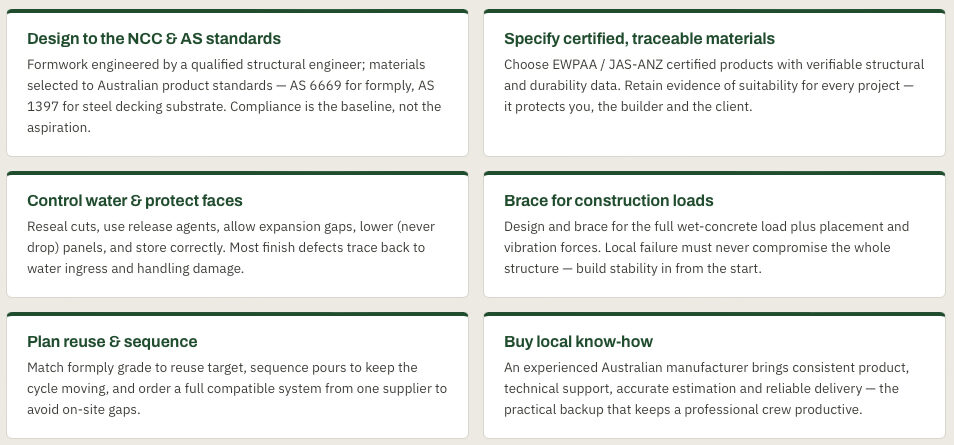
Formwork industry best practice in Australia
The standards and the habits that define the trade professional
Good formwork is invisible because everything it touches is right.
Straight slabs, crisp edges, clean off-form faces, safe scaffolds and an on-time pour cycle are the quiet proof of a skilled formworker. It starts with compliant, correctly-selected materials and ends with disciplined on-site practice. That combination is what separates a professional formwork tradesperson from the rest – and it’s exactly what this guide is built to support. Feel free to always talk to a Big River Formwork Specialists who have decades of experience and have likely encountered the exact challenge right in front of you today.
Formwork products

ArmourForm Formply - F17
Structural plywood for concrete formwork. F17 stress grade.
Residential and commercial concrete formwork

ArmourForm Formply - F22
Structural plywood for concrete formwork. F22 stress grade.
Commercial and residential concrete formwork

ArmourForm Formply - F27
Structural plywood for concrete formwork. F27 stress grade.
Commercial concrete formwork

Deckply F17
A high-quality plywood panel developed & engineered from graded eucalyptus veneers.
Off-form Concrete Finishes

ArmourDeck™ Steel Formwork
Permanent steel formwork for suspended concrete slabs
Multi-storey suspended slabs

FormBEAM LVL
Purpose-engineered Laminated Veneer Lumber (LVL) for high-performance concrete formwork applications.
Formwork LVL

RedEdge
RedEdge features a square edge for clean concrete formwork finishes.
Formwork

Formwork Accessories
Big River Group provides a full range of Formwork accessories, from nails and saw blades to shoring systems, braces...
Concrete formwork and accessories
Projects to discover ideas

Dylan Lane, Byron Bay
A thoughtful coastal renovation grounded in timber craftsmanship Set against the lush, subtropical backdrop of Byron Bay, the...

Geelong Waterfront Pavilion
A public waterfront pavilion in Geelong, VIC, featuring Armourpanel decorative plywood panels for ceiling linings and spotted gum...

Henley Street Residence
Contemporary residential project showcasing Scyon cladding and structural timber framing.

Pointside: Coastal Sanctuary
Quiet luxury with Big River Group timber at the heart of the home. Set in the quiet coastal...