
What is formply? A guide to formply vs normal plywood
Formply vs Plywood are similar but different. It can get confusing as there are so many different types of plywood and formply products on the market, so we have put together a helpful guide to help the trade select the right product for the right concrete formwork job. With over 130 years of timber and formwork experience, we have put together this helpful 'Understanding Formply vs Normal Plywood Guide' to make things easier for you.

Download the formply vs plywood guide (PDF)
Key features and benefits of formply vs normal plywood
Our helpful guide will go through the various features and benefits to make understanding easier.
What is the difference between Formply vs Normal Plywood?
‘Formply’ and ‘plywood’ are not interchangeable. Formply is a structural plywood with a film-faced surface, made to AS 6669 to be the face of concrete formwork – the film releases cured concrete cleanly and protects the panel between pours. Big River has manufactured formply (its ArmourForm range) at the Grafton NSW mill for decades, in F17, F22 and F27 stress grades.
This guide explains how real formply differs from normal plywood, and the trade tips that get the most out of it.
Understanding the technical terminology and differences between formply vs normal plywood
What is Formply?
Formply is not general-purpose plywood. It is a structural plywood panel with a film-faced surface, manufactured to AS 6669 for use as the face of concrete formwork. Two things make it a distinct product: the film face, which releases cured concrete cleanly and gives a specified off-form finish, and the stress-graded construction beneath it, which carries the live load of a pour.
Big River manufactures its ArmourForm formply at the Grafton NSW mill and has done for over 40 years, in F17, F22 and F27 stress grades. It is EWPAA stamped, JAS-ANZ accredited and PEFC chain-of-custody certified (PEFC/21-31-174), with Super E0 low-emission construction. Big River also manufactures ordinary structural plywood at the same mill – so the difference between the two is a certified distinction, not a marketing label.
It’s all about the face. The film face is what separates formply from normal plywood. It does the opposite of what a normal timber veneer does: instead of accepting glue, paint or coatings, it is engineered to let go of cured concrete, strip clean, and protect the panel so it can be poured against again. That release face – plus a certified off-form finish class – is exactly what a concrete pour needs and what ordinary plywood cannot give.
Two different standards, two different jobs
- Formply AS 6669. Certified for concrete formwork: a film-faced panel engineered to release concrete and deliver a specified off-form finish.
- Structural plywood AS/NZS 2269. Certified for load-bearing jobs – flooring, bracing and roofing – with a timber veneer face, not a release film.
- Marine plywood AS/NZS 2272. Different again: void-free construction for prolonged moisture (boat building), not a formwork product.
Formply (ArmourForm) - Features, Benefits & Applications
ArmourForm is Big River’s film-faced formply, purpose-built as the contact face of concrete formwork and made to carry the live load of a pour while delivering a clean, repeatable off-form finish.
Features
- Film-faced structural plywood manufactured to AS 6669 specifically for concrete formwork.
- Three stress grades – F17, F22 and F27 – to match load, reuse and application.
- Australian made at the Grafton NSW mill for 40+ years; EWPAA stamped and JAS-ANZ accredited.
- PEFC chain-of-custody certified (PEFC/21-31-174) with Super E0 low-emission construction.
Benefits
- Clean concrete release – the film face lets cured concrete strip away cleanly, protecting both the slab face and the panel.
- Consistent off-form finish – reliably delivers an AS 3610 Class 2 finish on the first pour with appropriate release agents (Off-Form Premium is available for a superior Class 2).
- Reuse between pours – the protected face means many castings per sheet, turning cost per sheet into a lower cost per pour.
- Engineered to carry the pour – stress-graded construction handles the live load of concrete placement, not just the surface job.
- Certified compliance – EWPAA / JAS-ANZ / AS 6669 gives you the paperwork your job needs.
Typical applications
- The contact face of concrete formwork: slabs, footings, columns, walls, tilt-up panels and system formwork.
- F17 for most residential and light-commercial pours; F22 for system formwork and multi-storey work.
- ArmourForm F27 (total hardwood construction) for heavy civil – table forms, jump forms and mining infrastructure.
Choosing the stress grade
| Grade | Typical application | Reuse expectation |
| F17 | Slabs, footings, tilt-up panels; residential & light commercial | Confirm with your branch |
| F22 | System formwork and multi-storey pours where reuse cycles matter |
Higher strength-to-weight; confirm with branch |
| F27 | Heavy civil: table forms, jump forms, mining infrastructure | 50+ castings under good site practice |
Note: this is a guide only, please check with your Big River branch for your exact product use and project application.
Normal Plywood - Features, Benefits & Applications
Normal Plywood – What It’s For (and Why It Isn’t Formply)
Structural plywood is a genuinely useful product – it is simply built for a different job. Made to AS/NZS 2269, it is a load-bearing panel with a timber veneer face. The trouble starts only when it is pressed into service as formwork, where it is missing the two things that matter most: a release face and a certified off-form finish.
What normal (structural) plywood is for
- Load-bearing construction under AS/NZS 2269 – flooring, bracing and roofing.
- Jobs where the panel carries or distributes load and the surface is not a concrete face.
- Applications that will be glued, coated or painted – a timber veneer accepts adhesion; a formply film face does not.
Why it isn’t a formwork substitute
- No release face – concrete bonds to a bare veneer and tears the surface on strip, damaging both slab and sheet.
- No finish-class performance – it isn’t rated for an AS 3610 off-form finish, so the concrete surface is a lottery.
- Not certified to AS 6669 – it carries load, but relies on a formwork certification it doesn’t hold.
- Short life in formwork – with no protective film it degrades fast against wet concrete and won’t reuse.
And marine ply isn’t the answer either. Marine plywood (AS/NZS 2272) is graded for void-free construction and prolonged moisture – boat building and permanently wet environments. Neither product is ‘better’; they’re built for different jobs. Using marine ply as formwork pays for properties a pour doesn’t need, and using formply in a marine application relies on a certification it doesn’t hold.
Key Differences Explained
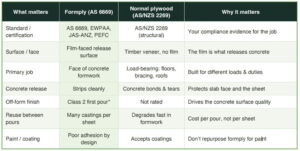
Both are plywood; only one is built for a concrete pour. The table sets real formply against normal structural plywood across what matters on formwork. It comes down to the face and the certification. Normal plywood can carry the load of a pour, but without a release film the concrete bonds to it, the strip tears the surface, and there is no rated off-form finish – so the concrete face is unpredictable and the sheet is spent quickly. Formply is engineered for exactly that surface job and certified to AS 6669 for it. Choose by the duty the panel has to perform, not by the fact that both happen to be plywood.
Getting It Right on Site
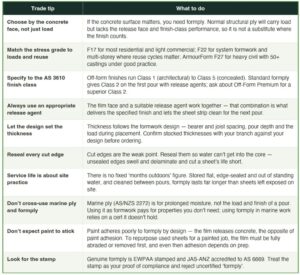
Formply is just that – plywood specifically made for concrete formwork applications. Here some more practical points that separate a clean, compliant, reusable pour from a costly one. Of course, always check with your local Big River branch and formwork expert to make sure you have the exact Formply you need for your specific application. It’s better to ask and check before you get to work!
Formply product range

ArmourForm Formply - F17
Structural plywood for concrete formwork. F17 stress grade.
Residential and commercial concrete formwork

ArmourForm Formply - F22
Structural plywood for concrete formwork. F22 stress grade.
Commercial and residential concrete formwork

ArmourForm Formply - F27
Structural plywood for concrete formwork. F27 stress grade.
Commercial concrete formwork

Deckply F17
A high-quality plywood panel developed & engineered from graded eucalyptus veneers.
Off-form Concrete Finishes
Formply FAQs
Is formply waterproof?
Formply has a film-faced surface and a water-resistant glue bond that hold up to water during a concrete pour, but it is not a permanently waterproof product. The face sheds water and release agent, while the cut edges are the vulnerable point and should be sealed. Store formply flat, undercover and off the ground. Prolonged exposure and unsealed edges shorten its working life.
What thickness does formply come in?
Big River ArmourForm formply is manufactured to AS 6669 in 12mm, 17mm, 19mm and 25mm thicknesses, 1200mm wide, in 2400mm and 1800mm sheet lengths. 17mm is the most widely used formwork thickness. The right thickness depends on your formwork design – the bearer and joist spacing, the pour depth and the placement load – so confirm what your nearest branch stocks against your design.
Is formply better than marine ply?
They are certified for different jobs. Marine plywood is made to AS/NZS 2272 for void-free construction and prolonged moisture exposure, such as boat building. Formply is made to AS 6669 for the load and the off-form finish of a concrete pour, with a film face that releases cured concrete cleanly. For concrete formwork, formply is the right sheet; marine ply is not a substitute where the off-form finish matters.