
Maxiwall AAC Acoustic Performance
Building with Maxiwall AAC Acoustic Wall Panels is the smarter, faster and cost-saving way for modern home and low-density housing construction. AAC acoustic panels help trades on site with lighter and more time-saving walling installations with better thermal, acoustic and fire-rating performance.


Excellent acoustic performance
Maxiwall AAC wall cladding gives trades a lightweight, solid wall system with excellent acoustic performance, helping create quieter homes with less noise transfer between rooms and from the neighbours outside.
- High sound insulation for a lightweight system
- Acoustic performance equivalent to thicker masonry
- One wall system for acoustic, fire and thermal

How AAC Wall Cladding Improves Sound Insulation in Homes
AAC wall cladding provides superior acoustic performance for residential builders and trades by combining the mass of masonry with a sound‑absorbing cellular structure that significantly reduces noise transmission.
- Cutting traffic noise
- improving privacy between rooms
- Better noise control between intertenancy walls
Technical acoustic compliance certificate
Acoustic performance in free-standing home and low-density housing has become more important in today’s home. It’s important to check the technical specifications of each product and importantly the construction method to maximise the acoustic envelope constructed.
Key technical summary on AAC acoustic performance
- The technical difference: AAC’s porosity makes it an efficient sound barrier per unit of mass, not a magic bullet that beats dense masonry of equal thickness. Sound insulation of a single solid leaf is governed primarily by mass per unit area (Berger’s mass law: Rs ≈ 14.5 log₁₀(m) + 10 dB).
- The practical difference: Pound-for-pound (per kg/m²), AAC equals or beats clay brick and dense concrete. At identical thickness, denser masonry can edge ahead on raw transmission loss because it has more mass — but AAC wins on weight, structural load, buildability and thermal performance.
- The winning detail: AAC’s real acoustic advantage is realised in lightweight composite systems — AAC + cavity + insulation + plasterboard — which exploit the mass-air-mass resonance principle to reach Rw 50+ at low total weight.
Construction professionals can sometimes confuse two distinct properties:
- Sound insulation (barrier): the ability of an element to stop airborne sound passing from one space to another. Measured as transmission loss / Rw / STC. This is what building codes regulate.
- Sound absorption: the ability of a surface to soak up sound energy within a room and reduce reverberation/echo. Measured by the absorption coefficient (α). AAC’s open surface texture gives it useful absorption — relevant to reverberant spaces such as plant rooms, car parks, gyms and pools.
Acoustic performance is how AAC panels are made
AAC is manufactured from fine silica (sand or fly ash), cement, lime, water and a small quantity of aluminium powder. The aluminium reacts with the alkaline slurry to release hydrogen, which expands the mix like a cake before it is wire-cut and autoclaved (high-pressure steam cured). The result is a rigid mineral matrix riddled with millions of fine air cells. Because 60–70% of AAC by volume is air, its dry density is far below conventional concrete — typically 400-650 kg/m³ across AAC products generally – Big River’s MaxiWall panels are certified at 510 kg/m³ nominal dry density (50mm) and 400 kg/m³ (75mm), versus roughly 1,900–2,400 kg/m³ for dense concrete and clay brick.
International Masonry Institute, “Autoclaved Aerated Concrete Masonry Units” — AAC is 60–70% air; high surface mass plus mechanical vibration damping within the porous structure attenuates sound.
Related: the MaxiWall AAC panel system, fire rated AAC panels (party walls need both ratings) and our full AAC range.
Frequently Asked Questions
What acoustic ratings do MaxiWall systems achieve?
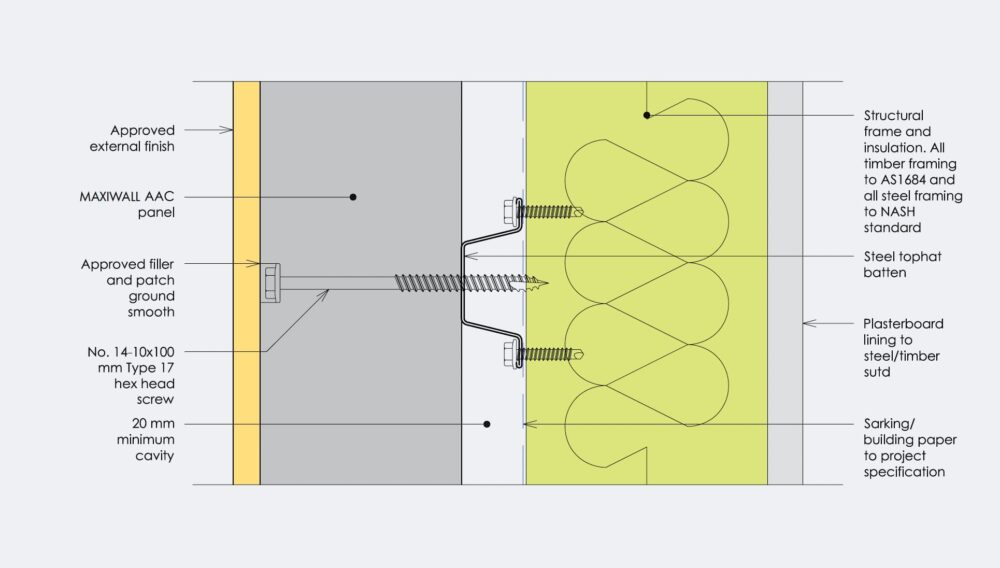
Documented 75mm MaxiWall external wall systems achieve sound insulation ratings of Rw 38 to 42 (Rw+Ctr 23 to 27) depending on the lining build-up (75mm installation guide, Table 4). Acoustic performance always depends on the complete wall system, not the panel alone.
Can MaxiWall be used for party walls?
Yes. The documented party wall system is designed to meet the NCC requirement of Rw+Ctr 50 using discontinuous construction, together with a 60/60/60 fire resistance level – the combination the code demands between attached dwellings.
Why is AAC effective at blocking sound?
AAC combines useful surface mass with millions of fine air cells that damp vibration, so it outperforms many materials of similar weight. Pairing the panel with the documented lining systems is what delivers the certified ratings.
Discover more about AAC walling acoustic benefits
Products for better acoustic walling construction

MaxiWall AAC Panel System
Lightweight AAC wall panel system for fast internal and external walling.
Fast, cost-effective walling for residential and commercial

MaxiFloor Structural Flooring
Engineered flooring system for residential and commercial builds.
Multi-storey floor systems

Helix AAC
Helix AAC Panels are a next-generation external wall system that combines the strength of concrete with outstanding thermal and acoustic performance.
Bushfire-prone area construction