
A Guide to MGP10 vs MGP12 Timber
With so many different structural timbers on the market these days, the right selection can get pretty confusing. With over 130 years of timber experience, so we have put together this helpful 'MGP10 vs MGP12 Guide' to make things easier for you.
Our guide will help you choose the right structural pine for Australian home building — along with understanding the main features, benefits, applications and selection criteria.
The main difference is stiffness. MGP10 clears a minimum Modulus of Elasticity of ~10,000 MPa; MGP12 clears ~12,700 MPa — about 27% stiffer, with bending strength jumping from 17 to 28 MPa. Both are the same seasoned plantation pine (i.e. radiata/slash/caribbean), machine-graded under AS/NZS 1748 with design properties from AS 1720.1. The only difference is measured performance, not species or appearance.
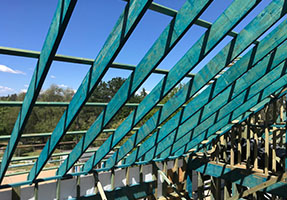
Key Features & Benefits of MGP10 vs MGP12
Our helpful guide will go through the various features and benefits to make understanding easier.
What is the difference between MGP10 vs MGP12 grades?
Choosing the right structural timber starts with understanding the differences between MGP10 vs MGP12. Machine-Graded Pine (or MGP) is the standard framing material for Australian residential construction, graded to AS 1748.
Machine Graded Pine (MGP) is the workhorse of Australian residential framing. MGP10 and MGP12 look almost identical on the rack, but they behave differently under load.
- MGP10 is the most widely specified grade that is suitable for wall frames, roof trusses, and general-purpose framing.
- MGP12 offers higher stiffness and is specified where greater spanning capacity or load performance is required, such as long-span floor joists or heavily loaded lintels.
Our guide explains in more detail what separates the two grades, where each earns its place in a build, and how to specify with confidence.
Understanding the technical terminology and differences between MGP10 vs MGP12 timber
What is Machine Graded Pine?
MGP stands for Machine Graded Pine — seasoned (kiln-dried) plantation softwood, most commonly radiata, slash and Caribbean pine. Rather than being assessed by eye, every length is fed through a machine stress grader that flexes the board and measures how much it deflects under a known force. That deflection gives the timber’s stiffness, or Modulus of Elasticity (MOE), which the machine correlates to strength before sorting and stamping each piece with a grade.
The grading regime sits under AS/NZS 1748, while the structural design properties assigned to each grade are published in AS 1720.1 (Timber Structures). The number in the grade name is the headline: it is the minimum stiffness threshold in gigapascals. MGP10 clears roughly 10,000 MPa, MGP12 clears about 12,700 MPa, and MGP15 (the top standard grade) around 15,200 MPa. The higher the number, the stiffer and stronger the board.
MGP is not the same as F-grade. F-grades (F5, F7, F17…) are anchored to bending strength alone and are often applied by visual grading. MGP grades carry a full set of design properties — bending, tension, shear, compression and stiffness. Because of this, MGP timber may be substituted where a compatible F-grade is specified (e.g. MGP10 for F7), but the reverse is not permitted: never drop F-grade material into a slot the engineer specified as MGP.
How the grade is decided
- Stiffness (MOE) — measured directly by machine deflection; graded on the average, because how far a member sags is what governs serviceability.
- Strength — bending, tension and compression capacities are assigned on a conservative fifth-percentile basis, so at least 95% of pieces in a grade exceed the rated value.
- Consistency — X-ray and mechanical sensors, calibration checks, moisture monitoring and independent auditing keep each stamped grade reliable.
The Two Grades at a Glance
| MGP10 | MGP12 | |
| Technical Criteria | The residential default | The higher-performance grade |
| Modulus of Elasticity (E) | 10,000 MPa | 12,700 MPa |
| Bending strength (f’b) | 17 MPa | 28 MPa |
| Tension parallel (f’t) | 7.7 MPa | 12 MPa |
| Compression parallel (f’c) | 18 MPa | 24 MPa |
| Shear (f’s) | 2.6 MPa | 3.0 MPa |
| Nearest F-grade | F7 / F5 | F8 |
Characteristic design values from AS 1720.1 (seasoned timber). Values are indicative of the grade; actual member capacity also depends on size, load duration, moisture and other modification factors applied by the designer. Please check the exact product certification with from our friendly Big River team.
Key Differences Explained
The two grades share a species, a look and a treatment range. What separates them is measured performance. The table below shows the characteristic design values side by side, with the practical uplift MGP12 delivers.
Reading the numbers
Stiffness is usually the deciding factor in housing. Most framing is limited by how far it deflects (serviceability) long before it is at risk of breaking, so MGP12’s 27% stiffness advantage is what lets it span further or bounce less. The larger jump in bending strength matters most for heavily loaded members. In practice, an engineer or the AS 1684 span tables will translate these characteristic values into allowable spans for a given size, spacing and load — which is where the grade choice becomes concrete.
Characteristic values per AS 1720.1 for seasoned MGP. Uplift figures are approximate and compare grade-to-grade capacities, not finished member capacities. Please check exact product specifications with the friendly Big River technical team.
MGP10 - Features, Benefits & Applications
MGP10 is the most widely used structural pine grade in Australian housing.
It is the cost-effective baseline that most everyday framing is designed around — reliable, readily available in every yard, and comfortably strong enough for standard spans and spacings.
Features
- Minimum stiffness of about 10,000 MPa (MOE) — the entry point of the MGP scale.
- Seasoned plantation pine with a clean, uniform, machine-graded appearance.
- Supplied in the full range of common framing sizes (70, 90, 120, 140, 190 mm depths in 35/45 mm thicknesses).
- Available in preservative treatment levels (e.g. H2 blue for internal framing, H3 for protected external use) — treatment is separate from structural grade.
Benefits
- Economy — the lowest-cost structural grade; ideal where the design does not demand extra stiffness.
- Availability — stocked everywhere, so lead times and substitutions are rarely an issue.
- Design support — AS 1684 span tables and manufacturer literature are built around MGP10, making it quick to size and certify.
- Workability — light, easy to cut, nail and fix by hand on site.
Typical applications
- Wall framing — studs, plates and noggings in load-bearing and non-load-bearing walls.
- Roof framing — rafters, ceiling joists, battens and general roof members at standard spans.
- Floor joists and bearers within span-table limits.
- General light-load framing, subframes and everyday residential carpentry.
MGP12 - Features, Benefits & Applications
MGP12 is the step up.
With roughly 27% more stiffness and markedly higher bending strength than MGP10, it lets a member span further, carry more, or be sized down for the same job. It costs more and is not stocked as deeply, so it is specified where performance genuinely earns its keep.
Features
- Minimum stiffness of about 12,700 MPa (MOE) — noticeably stiffer than MGP10.
- Higher characteristic bending, tension and compression capacities across the board.
- Same species and seasoned pine base as MGP10 — the difference is structural, not visual.
- Available in the same sizes and treatment levels, though stock depth varies by supplier.
Benefits
- Longer spans — greater stiffness means less deflection, so members reach further before hitting
- serviceability limits.
- Higher loads — better suited to concentrated or heavier loads such as floor systems and supporting members.
- Design flexibility — can allow a shallower or thinner section for the same span, freeing up ceiling height or reducing member count.
- Headroom — useful where deflection or bounce needs to be tightly controlled (e.g. stiffer floors).
Typical applications
- Floor joists and bearers on longer spans or heavier floor loads.
- Rafters and roof members where span or load exceeds comfortable MGP10 limits.
- Lintels and supporting members within engineered or span-table provisions.
- Situations where an engineer specifies the higher grade to control deflection or reduce member size.
Key Selection Criteria
Grade is only one of several decisions when specifying structural pine. Work through these together rather than in isolation.
| Criterion | What to look for |
| Structural demand (span & load) | Start here. Check the AS 1684 span tables or the engineer’s design for the member, size, spacing and load. If MGP10 spans it comfortably, there is rarely a reason to pay for MGP12. If it is marginal, MGP12 (or a deeper section) closes the gap. |
| Deflection & serviceability | For floors especially, stiffness governs bounce and feel. Where a springy floor is a risk, MGP12’s higher MOE is often the cleaner fix than upsizing. |
| The specification is binding | If the engineer, span table or certifier calls up a specific grade, match it. You may substitute MGP up for a compatible F-grade, but never substitute down or swap an MGP call-out for F-grade. |
| Durability & treatment (H-class) |
Structural grade and durability are separate. Match the hazard level to the exposure — H2 for protected internal framing, H3 for above-ground external, and higher for damp or ground contact. Untreated pine is unsuitable for exposed or damp locations. |
| Size & availability | MGP10 is stocked deeply in all common sizes; MGP12 stock varies by supplier and region. Confirm availability and lead time before designing around it. |
| Cost & overall economy | MGP12 costs more per length, but if it lets you use fewer or shallower members the total can be competitive. Weigh material cost against labour, member count and headroom. |
| Grade stamp & compliance | Only use timber that is clearly and legibly grade-stamped. The stamp is your evidence of compliance for certification — reject unmarked or illegibly marked structural timber. |
| Moisture & storage on site | Keep seasoned pine dry, stacked and ventilated. Poor storage causes movement, warping and checking that can compromise otherwise sound structural timber. |
Summary Comparison MGP10 vs MGP12 grades
The main points at a glance. Use this as a quick reference, not a substitute for the span tables or the engineer’s design. Always check with our Big River technical team to ensure you select the right structural timber material for your specific home building application.
Bottom line: Use MGP10 as your default for standard residential framing — it is cheaper, everywhere, and strong enough for most walls, roofs and joists. Reach for MGP12 when you need to span further, carry more, control deflection, or size a member down. Above all, when a grade is specified, match or exceed it — never substitute down.
| Aspect | MGP10 | MGP12 |
| Positioning | Residential default / baseline grade | Higher-performance upgrade grade |
| Stiffness (MOE) | ~10,000 Mpa | ~12,700 MPa (+27%) |
| Bending strength (f’b) | 17 Mpa | 28 MPa (+65%) |
| Relative strength | Strong enough for standard framing | Stronger & stiffer across the board |
| Best for | Walls, roof framing, general framing, standard joists | Longer-span joists/bearers, heavier loads, tighter deflection |
| Spans | Standard spans per AS 1684 | Longer spans or shallower sections for same span |
| Cost | Lower — most economical | Higher per length |
| Availability | Stocked everywhere, all common sizes | Varies by supplier / region |
| Nearest F-grade | » F7 | » F8 |
| Substitution rule | MGP may replace compatible F-grade; F-grade must NOT replace an MGP call-out |
As per MGP10 — always match or exceed the specified grade |
A guide to understanding MGP10 vs MGP12 timber
Product range

Structural Pine Framing
MGP10 and MGP12 structural pine for wall frames and roof trusses.
Residential and commercial framing